Lead Came Technique
The lead came technique is one of the oldest and most enduring methods used in the creation of stained glass, dating back to medieval Europe. This technique relies on strips of lead, known as cames, which have an H-shaped cross-section or a C-shaped cross section, designed to hold individual pieces of glass securely along their edges. The flexibility of lead allows the artist to accommodate complex shapes while maintaining structural strength.
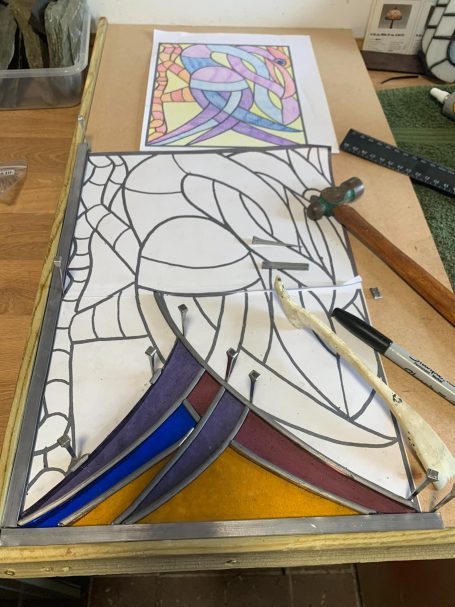
The process begins with a full-scale design, or cartoon, which serves as a precise guide for cutting each piece of glass. Once the glass is cut and fitted, the pieces are assembled on a flat surface using lead cames to connect them. Each joint is then soldered, usually with a tin-lead alloy, to lock the structure together. The panel is reinforced with support bars when necessary, especially for larger windows.
After soldering, a waterproofing compound, or cement, is brushed into the gaps between the glass and lead. This step strengthens the panel and prevents movement or water ingress. Finally, the stained glass is cleaned and polished, revealing crisp lines and luminous colour. The lead came technique remains valued for its durability, distinctive line quality, and its ability to transform light into richly patterned form.